Agents Will Create Data We’ve Never Seen Before
The enterprise data story is about to get a new chapter — and most people are barely thinking about it.

I’ve written a fair amount about data over the past few months (thanks for your patience with me). I’ve written about how AI is changing your relationship with it. About the data moats that separate defensible companies from vulnerable ones. About the enterprise data debt — at least three decades of deferred decisions that AI just made “code red”. And about the new class of human work emerging around Agent Ops, the people who fix the upstream data discipline so that agents can function at all.
In my last post, I made the argument that in software judgment doesn’t sit beside execution — it sits above it. Before any AI system runs, a I believe a human created what question to ask, what counts as correct, and what to do when reality falls outside the expected range. AI handles the inner loop. Humans define and own the outer one — let’s call it the judgment envelope.
The next step is interesting, and I explore it here. Once you accept that agents are entering enterprise workflows — not as toys, but as “workers” — and that every one of them operates inside a judgment envelope defined by humans, you must ask another question:
What happens to the data that agents create?
The Data We Know
Critical enterprise data, as we’ve understood it for decades, lives in systems of record. ERPs, CRMs, HCMs, financial platforms. These systems exist because enterprises cannot afford ambiguity about the “truth”. A financial close platform, a compliance system, an ERP that holds the authoritative record of what was ordered, shipped, invoiced, and recognized as revenue — these aren’t going anywhere.
But systems of record were designed for a world where humans were the primary actors. Humans labored over the transactions. Humans entered data. Humans made the judgment calls that the systems then recorded. The cadence of data creation was human-speed: quarterly closes, daily order entries, weekly pipeline updates. The shape of the data reflected human workflows — and critically, the judgment embedded in those workflows was invisible. It lived often in people’s heads, in institutional culture, in the unwritten rules about how decisions actually got made.
That world is ending. Not because systems of record are going away — they’re not. But because a new class of actor is about to start generating data at a pace, granularity, and volume that those systems were never designed to handle. Unlike human actors, agents leave a trail of every judgment boundary they operated within — and every one they bumped up against.
Agents as Data Creators
Here’s what most of the agentic AI conversation just doesn’t cover. The focus is overwhelmingly on agents consuming data — reading from systems of record, querying databases, pulling context. That’s important, and it’s why I’ve argued that clean data is the prerequisite for any serious agent deployment. Garbage in, confident garbage out.
But agents don’t just consume data. They produce it.
Every agent interaction generates artifacts: the reasoning chain that led to a recommendation. The options considered and rejected. The confidence scores assigned to each decision branch. The sequence of tools invoked. The context assembled from multiple systems. The user feedback that shaped the next iteration.
Here’s what makes this data unique from anything enterprises have managed before: it’s a record of the judgment envelope in action. Not just what happened — any system of record can tell you that. But how the decision was thought through, what the agent was permitted to consider, where it operated autonomously, and where it hit the boundary and handed off to a human. Every override, every escalation, every time a human expanded or tightened the envelope — that’s data now. Judgment that used to be invisible and institutional is becoming empirical and auditable.
Consider a financial services firm deploying agents to draft client communications, assess risk profiles, and flag compliance issues. Every one of those interactions generates a decision trail — but more importantly, it generates a record of where the judgment envelope held and where it didn’t. The agent assessed a client as low-risk within the parameters it was given. The compliance officer overrode that assessment based on context the agent didn’t have. That override isn’t just an exception log. It’s a signal that the envelope was too narrow for that class of situation. Multiply that by thousands of interactions, and you have something no enterprise has ever had: a continuously updating empirical map of where human judgment is still required and where machine autonomy is safe.
In many jurisdictions, that trail is going to be required. And it lives nowhere in today’s system-of-record architecture.
New Emerging Data Categories
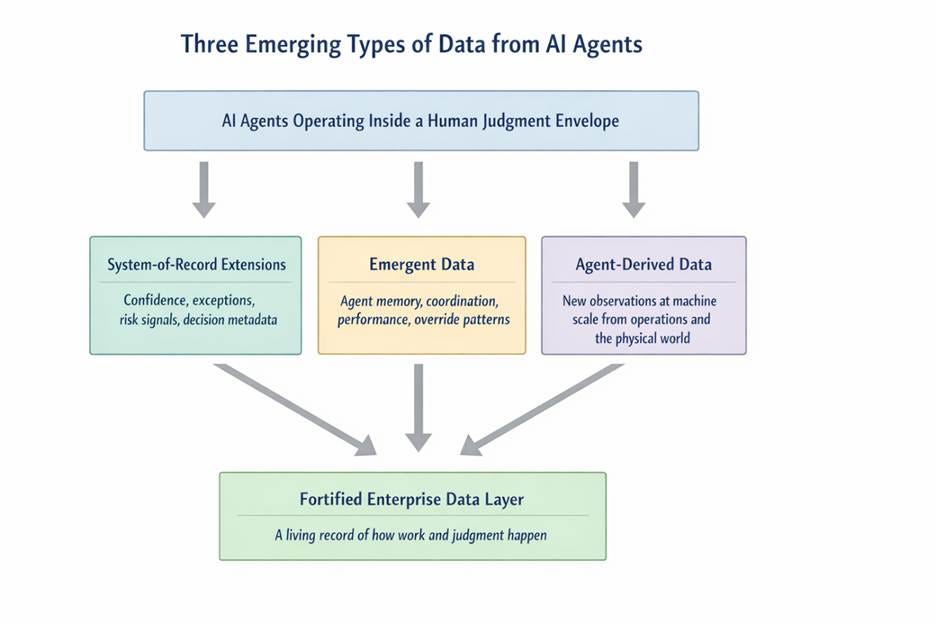
I see agents creating data that falls into three broad categories, each with different implications for enterprise architecture and strategy. The judgment envelope framework helps clarify what makes each one valuable.
The first is what I’d call system-of-record extensions. These are structured outputs that flow back into existing enterprise systems but at a different cadence and granularity. An agent that processes invoices doesn’t just match the PO and approve; it generates exception logs, confidence assessments, vendor risk signals, and pattern-match data across thousands of transactions simultaneously. That metadata enriches the system of record in ways that human-speed processing never could. The ERP still holds the authoritative transaction. But the intelligence layer around it — the why behind every decision — is entirely new.
Through the judgment lens, these extensions are a record of the envelope operating as designed. The agent stayed within its boundaries. The confidence was high. The human didn’t need to intervene. That confirmation data has real value — it tells the enterprise which processes are mature enough for deeper automation and which envelope definitions are working.
Databricks reported recently that more than 80% of databases in their customer base are now being built by AI agents. That’s not agents querying existing databases. That’s agents creating new data structures to hold the artifacts of their own work. The infrastructure is already shifting underneath us.
The second category is new: what I call emergent data. These are data sets that have no precedent in enterprise IT. They include agent memory — the accumulated context an agent builds about a domain, a customer, a workflow over time. They include cross-agent coordination data — the handoffs, negotiations, and shared context between specialized agents working on the same problem. And they include the meta-layer: performance data about the agents themselves. Which agents are reliable. Which ones drift. Where confidence degrades. How human overrides correlate with downstream outcomes.
This is where the judgment layer framework helps. Emergent data isn’t just another log — it’s the evolving record of how an enterprise makes decisions at the boundary between human and machine. Every override refines the map. Every successful autonomous action confirms a boundary. Over time, this emergent data becomes an empirical model of the enterprise’s own judgment architecture — something that has never existed across the enterprise in codified form before.
This is the data layer that sits above systems of record and below human decision-making. It’s the connective tissue between what the enterprise knows and what the enterprise does.
The third category is an expansion on today’s inconsistent data sets: agent derived data. This is observational data that was always theoretically possible to collect at scale but economically unfeasible for humans to capture. Wear patterns on equipment components across thousands of operating hours. Micro-variations in supplier delivery timing correlated with weather, port congestion, or driver routing. Subtle degradation signatures in manufacturing tolerances that predict failures weeks before they happen. Maintenance logs enriched not just with what was done, but with the full sensor context of why it was triggered.
None of this is new information in the physical world, and to be fair some of it has been captured before through monitoring software. But it has never been done at the scale agents will allow, or at anything close to this cost. Machines have always worn down, deliveries have always varied, tolerances have always drifted. What’s new is the scaled economics. The cost of a human noticing, recording, and systematizing these observations was prohibitive at the granularity required to make them useful. Agents flip that equation entirely. The marginal cost of an agent observing, logging, and correlating one more data point approach zero. Suddenly, data sets that failed the ROI test at human labor rates become not just feasible but abundant.
Through the judgment lens, derived data is different from both other categories. System-of-record extensions capture the envelope operating as designed. Emergent data captures the boundary between human and machine judgment. Derived data captures what the enterprise couldn’t previously afford to know about its own operations. It’s the digital exhaust of agents doing work that humans would never have been assigned — not because it wasn’t valuable, but because the value couldn’t justify the cost. An agent monitoring equipment performance doesn’t just flag failures; it builds a continuous, granular history of operating conditions that no maintenance team would ever have had the bandwidth to compile. That history becomes a data asset in its own right — one that can predict, benchmark, and optimize in ways the enterprise never could before.
For industrial companies, healthcare systems, logistics operators, and anyone managing physical assets at scale, the third category may turn out to be the most commercially significant. It’s not just making existing decisions better — it’s creating entirely new categories of insight about the physical world that were previously invisible to the enterprise.
Together, these three categories — system-of-record extensions, emergent data, and derived data — represent the full scope of what agents are about to produce. And right now, almost nobody has a strategy for managing any of them.
The Impact on Enterprise Strategy
I’ve argued before that the companies with the strongest data differentiation are the ones best positioned for AI — that proprietary data is the fuel for AI-enhanced products, and the feedback loops between usage and model quality are what widen the moat over time. The market is already investing accordingly. In Deloitte’s 2026 Chief Data and Analytics Officer survey, 78% of respondents said their organizations are actively implementing data modernization, and 61% said improving data quality and access is essential for AI and agentic AI initiatives to succeed. Enterprises aren’t just buying models; they’re rebuilding the data foundations beneath them.
Agent-generated data amplifies that thesis dramatically. But the judgment layer changes what kind of differentiation we’re talking about.
Think about what happens when a vertical SaaS platform — a Veeva, a Procore, a Toast — deploys agents that generate domain-specific intelligence across their entire customer base. The agents don’t just serve individual customers; they learn where judgment envelopes hold and where they break across thousands of different operational contexts. Which contract structures lead to disputes — and more importantly, which envelope definitions around contract review prevented those disputes. Which supplier configurations predict delays — and which human overrides of agent recommendations correlated with better outcomes.
That cross-customer intelligence isn’t just pattern data. It’s judgment data — a proprietary record of which decision boundaries work in which contexts, accumulated across an entire industry vertical. It didn’t exist before agents, because no human could process the volume. And it creates a differentiator that’s harder to replicate than training data alone: you can’t reconstruct an enterprise’s judgment architecture from public information. You can only build it by operating inside real workflows, at scale, over time.
The feedback loop is powerful: better judgment data produces more reliable agents. More reliable agents earn more autonomy from human operators. More autonomy generates richer data about where the expanded envelope holds. The moat doesn’t just widen — it deepens in a dimension competitors can’t easily see, let alone copy.
For enterprises sitting on large, clean data assets, this is the growth unlock that most boards haven’t fully grasped. It’s not just about efficiency — doing the same things faster and cheaper. It’s about encoding proprietary judgment at scale and building products and services on top of that judgment that weren’t possible before. The enterprise that understands its own decision architecture better than its competitors has a structural advantage that goes far beyond automation.
The Curation Problem
But here’s the catch, and it connects directly to what I wrote about the Enterprise Data Debt.
Agent-generated data doesn’t curate itself. In fact, it has the opposite problem from traditional enterprise data. Where legacy data is too stale, too siloed, and too dirty, agent data is too abundant, too fast, and probably too unstructured. It compounds immediately. And without governance, it becomes noise at machine speed.
The judgment layer raises the stakes on curation considerably. If this data is the empirical record of how your enterprise makes decisions — and if your competitive advantage increasingly depends on the quality of that record — then curation isn’t an IT hygiene task. It’s the maintenance of a strategic asset.
The challenge breaks into three pieces.
First, quality. Agent outputs reflect the quality of their inputs and the reliability of their reasoning. If an agent is operating on stale data, its decision trails are contaminated — and the judgment map built on those trails is wrong. An enterprise that thinks it understands its own decision boundaries, but is working from corrupted data, will make systematically bad calls about where to extend agent autonomy. The enterprise data debt doesn’t just affect agent inputs — it propagates through agent outputs and corrupts the judgment record at-scale.
Second, governance. Agent-generated data often contains sensitive information — customer insights, competitive intelligence, employee performance signals — assembled in new combinations that may not have been anticipated by existing data governance frameworks. The judgment dimension adds another layer: override patterns can reveal individual decision-making styles, risk tolerances, and institutional disagreements. Who owns the cross-customer intelligence that an agent assembles? What are the privacy implications of agent memory that persists across interactions? What happens when the judgment record reveals that a team’s override patterns correlate with worse outcomes? These aren’t hypothetical questions; they’re the regulatory and organizational questions that will define the next wave of enterprise data management.
Third, evolution. Unlike traditional databases, agent-generated data sets are living systems. They change as models improve, as agents learn, as workflows adapt — and critically, as judgment envelopes are redefined. An emergent data set built on last quarter’s agent behavior may reflect envelope definitions that have already been expanded or tightened. Enterprises need versioning, lineage, and drift detection not just for the data, but for the judgment boundaries that shaped it — infrastructure that barely exists today.
The Opportunity
I keep coming back to a pattern I’ve seen across thirty years in this industry: the biggest opportunities emerge not when technology eliminates a problem, but when it creates a new category of problem that requires new solutions.
Cloud computing didn’t just make infrastructure cheaper. It created entirely new categories of work — cloud security, cloud cost optimization, cloud-native development — that generated massive markets.
Agents are about to do the same thing for data. And the judgment layer makes the opportunity larger than a pure infrastructure play, because the data agents create isn’t just operational exhaust — it’s the encoded decision architecture of the enterprise itself.
The companies that recognize this will have at least three advantages. They’ll have richer intelligence than competitors still treating agents as workflow automation tools. They’ll have defensible moats built on proprietary judgment that compounds with every agent interaction. And they’ll have the foundation for products and services that don’t exist yet — offerings built not just on patterns, but on decision frameworks that only become visible when agents and humans work together at scale.
The companies that treat agent data as exhaust — something to be logged — will find themselves in the same position as the enterprises that deferred their data maintenance for three decades. They’ll have a new kind of data debt, compounding faster than the old one, with higher stakes. Because this time, what’s degrading isn’t just data quality. It’s the enterprise’s understanding of its own judgment.
Where This Goes
We are in the very early innings of this transition. Most enterprises are still figuring out how to get agents to work reliably on existing data. The conversation about what agents create hasn’t started in most boardrooms.
But it will. And when it does, the framework will look familiar. Clean data is the foundation — that hasn’t changed. Systems of record remain the authoritative layer — that hasn’t changed either. The judgment envelope — humans defining the boundaries within which agents operate — remains the governing principle. What’s new is that all three are now producing a data layer that has never existed before: a living, empirical record of how the enterprise is making decisions.
Companies that invest in curating that layer — governing it, versioning it, building on it — will find scale advantages and growth avenues that aren’t visible from today’s vantage point. The data these agents create may turn out to be more valuable than the data they consume. Not because it’s bigger or faster, but because it unveils something that was always there but never captured: the judgment architecture that separates enterprises that know what they’re doing from those that merely think they do.
This piece builds on several earlier Substacks: “How AI Will Change Your Relationship With Data,” “AI and Data Moats: Where To Focus?,” “The Enterprise Data Debt,” and my recent piece on Agent Ops, and “The Three Layers.”
Crawford Del Prete is a Senior Advisor at PSG Equity and former President of IDC. He writes about enterprise software, AI, and technology market dynamics. All opinions are his.
It’s a great observation that we’re creating a new layer of data that sits between raw information and AI outputs. This data layer is much more difficult to comprehend than the System of Record data stored in rows and columns.
Three implications stand out:
1. Context becomes a strategic asset.
The memory, instructions, decisions, relationships, and operating history accumulated by agents begin to look a lot like process IP and trade secrets. How valuable is “the McKinsey Way?” How valuable are a set of markdown files? Two companies may have access to the same models, but they won’t have the same context layer. Over time, this accumulated context may become more valuable than the underlying model itself. That’s my bet hope/bet anyway.
2. The layer grows invisibly through work.
Unlike traditional databases, this information isn’t always intentionally created. It accumulates as agents perform tasks, make decisions, summarize conversations, update plans, and interact with each other. Every action leaves traces that shape future behavior. Most organizations won’t realize how much institutional knowledge has been created until it becomes indispensable. It can also be really, really opaque. The point about new tools created by new challenges applies here. I’ve been playing with Obsidian to help understand my context files more clearly and understand the connections between them. It breaks my brain, but someone will develop a new class of Context Observability tools.
3. Wrong thinking can become institutionalized at machine speed.
I’ve seen this already with a small agentic team. As agents do real work, they continuously update a shared memory spine. Occasionally something is wrong, incomplete, or simply not what I intended. The challenge isn’t just finding the bad output. It’s figuring out which memory, instruction, markdown file, or prior interaction introduced the error and fixing it.
In a traditional organization, bad assumptions spread slowly through conversations and habits. In an agentic organization, they can be written into memory, referenced by dozens of agents, incorporated into workflows, and reinforced through repeated use. A mistake doesn’t just persist. It can compound.
This suggests an emerging discipline that looks less like AI and more like knowledge governance: provenance, version control, auditability, and correction mechanisms for organizational memory.
Models may become commodities. Trusted context may not.
And I can only imagine what the lawyers will do with all of this. I wonder what CoWork Legal and Harvey.ai might say ;)