Enterprises Will Need an Agent Ops Team. Because It Turns Out the Hard Part Isn’t the Agents.
A new role is emerging across enterprise teams—and the people who master it won’t succeed because they understand AI. They’ll succeed because they understand workflows.

There’s a new role emerging because of AI: functionally, let’s let’s call it an “agent deployer and manager.” The more enterprises and suppliers I speak with, the more I hear about the need for this role. But the more I unpack the job companies want done, the more I think the hardest part isn’t the agents. It’s the workflows.
A new function is crystallizing around that challenge, embedded not in a central AI team but inside every function across the business. People are starting to call it Agent Ops.
Here’s a quote I saw recently: “I’m sitting on 50,000 customer contracts. What if I could have an AI agent go through all of them and figure out which customers have the highest propensity to buy the next product?” —Aaron Levie, Box CEO
Consider what that work looks like today without agents. A company sitting on 50,000 contracts probably has a renewals team that prioritizes outreach based on contract value, renewal date, and maybe a segmentation from a CRM. The highest-value contracts get personal attention. The mid-tier gets a templated email sequence. The long tail — thousands of smaller contracts — gets almost nothing, because there aren’t enough humans to read them, cross-reference product usage data, and identify which customers might be ready for an upsell. That analysis, done properly for every contract, might take a team of analysts months. It doesn’t happen. The work was never economically viable.
Now imagine an agent that can ingest every contract, pull in usage telemetry, cross-reference support ticket history, and surface a ranked list of customers with the highest propensity to buy the next product—continuously, not once a quarter. The volume and speed unlock is obvious. But here’s what’s less obvious: deploying that agent doesn’t just add a new capability to the existing workflow. It breaks the existing workflow. The renewals team’s entire operating model—how they prioritize, how they divide accounts, what the handoff to sales looks like, how they measure success—was designed around the constraint that deep analysis on every contract was impossible.
Remove that constraint and the process doesn’t just get faster. It needs to be fundamentally different.
This is the pattern that repeats across every enterprise function considering agents. The current workflow was shaped by human constraints — limited attention, limited throughput, limited ability to synthesize information across systems. Agents dissolve those constraints. But the workflow doesn’t automatically reshape itself to take advantage. It must be deliberately redesigned. That redesign is what most enterprises are underestimating and miscalculating.
Why workflows resist change
Workflows evolve slowly — much slower than the technology that’s supposed to change them. A workflow that evolved over five years to handle contract intake, or lead qualification, or client onboarding carries within it hundreds of invisible decisions: who owns which step, what happens when data is missing, which exceptions get escalated and to whom. That institutional knowledge isn’t well documented anywhere. It lives in people.
Technology, meanwhile, moves fast. Agent capabilities that didn’t exist twelve months ago are now reliable enough to deploy. The gap between what agents can do and what enterprises have restructured their workflows to take advantage of is widening every quarter. That gap is where value is being left on the table.
The reason workflows resist change isn’t purely technical — it’s social. People’s jobs, their accountability structures, and their professional identity are built around how work currently flows. An agent that technically could own a step doesn’t mean the team will let it. Changing a workflow means changing behavior, and that requires trust, authority, and time that pure technology deployments don’t account for.
What is the Agent Ops job?
The Agent Ops person starts by mapping workflows—but not automating them. They interrogate them. The first question isn’t “where can an agent help?” It’s “what does this workflow need to accomplish, and is the current process even the right one?” The worst outcome in agent deployment is making a broken workflow run faster. You just surface the dysfunction more efficiently.
The highest-leverage workflows share a recognizable profile: tasks where, if you threw compute at them, you could execute 100x faster or run them 100x more often than currently feasible. Examples: processing far more inbound leads with richer customer signal before they reach a rep; running contract review continuously rather than in batches; building a knowledge base the whole company can tap into dynamically. The volume and speed unlocks are real—but only once the underlying process is sound.
Then comes the genuinely gnarly work. Workflows evolved to tolerate messy, inconsistent data because humans are good at improvising. Agents aren’t. Clean handoffs, structured data, consistent inputs — these aren’t agent problems, they’re upstream human behavior problems. You often must fix data discipline before the agent can work, which means changing what people do before automation ever enters the picture.
ROUGH JOB DESCRIPTION
— AGENT OPS —
· Identify highest-leverage workflows where agents deliver 100x value in speed or volume.
· Redesign the future-state process—not automate the current one.
· Fix upstream data discipline so agents have clean, reliable inputs.
· Map structured and unstructured data flows across systems.
· Define human-in-the-loop interfaces and decision points.
· Connect business systems: APIs, MCPs, CLIs, skill layers in collaboration with the DevOps team.
· Manage evals after model or data changes; track KPIs continuously.
· Carry a mandate to drive workflow change—not just technical access.
Authority matters as much as skill
This is the part enterprises consistently underestimate. The Agent Ops person will hit walls where the blocker isn’t “can the agent do this” — it’s “whose sign-off do I need to change how contracts get routed?” or “which team owns this data and will they agree to structure it differently?” Those are organizational questions, not technical ones.
The companies moving fastest aren’t the ones with the most sophisticated AI strategy. They’re the ones where the people closest to the work have been given real mandate — not just tooling access — to redesign processes. Without that authority, Agent Ops becomes a suggestion box. With it, it becomes one of the highest-leverage functions in the company.
This is also why the role shouldn’t be centralized. A central AI team doesn’t know that the sales team’s lead qualification workflow breaks down every time a prospect comes in from a partner channel, or that the legal team has an undocumented triage system that lives entirely in one person’s head. The Agent Ops person must be embedded in the function, loyal to its outcomes, and trusted enough by the team to change how they work.
The skill profile is rare
What makes this role hard to fill is the combination it requires: business judgment, process design instinct, and enough technical depth to connect systems reliably with other teams such as DevOps. The person has to understand what creates value for the team, be willing to redesign workflows from scratch rather than digitize old ones, and be comfortable with the plumbing — MCPs, CLIs, APIs — in ways that are auditable and trustworthy.
Some will come from existing roles. The ops person who already understands the team’s workflows and is technical enough to learn new tooling. Business analysts, solutions engineers, technical program managers — many have most of the profile already and need only the mandate and the new technical vocabulary.
But this is also an exceptional entry point for new talent leaning into AI. You don’t need to be a pure engineer. You need to think rigorously about process, be comfortable with agent infrastructure, and care about business outcomes. That combination, rare today, will become a defined career track fast — and for engineers watching the job market shift, it’s one of the clearest paths forward. The skills transfer. The judgment required about where to apply technology is much harder to automate than the engineering itself.
Why management consulting firms will lead the training
There’s a natural question buried in everything above: if the Agent Ops role is this cross-functional, this context-dependent, and this hard to hire for — who teaches companies how to build it?
Many enterprises will try to figure it out internally. Some will task their existing IT or data teams with standing up the function. Others will assign it to a chief of staff or an innovation group. A few will create a new headcount and hope the right candidate materializes. Most of these efforts will stall — not because the people involved lack intelligence or ambition, but because building Agent Ops from scratch requires something internal teams rarely have: a reference point for what the function looks like when it works. You can’t pattern-match your way to a new operating model if you’ve only ever seen your own. The teams that try to build it alone will spend months reinventing frameworks that someone else has already pressure-tested, and they’ll hit the same organizational walls — data ownership disputes, unclear mandates, workflow redesign resistance — without a playbook for navigating them.
There’s a deeper problem, too. Without executive sponsorship and the organizational authority that comes with it, the company’s DNA will reject the change. Workflows aren’t just processes — they’re expressions of how a company has decided to operate, reinforced by years of habit, incentive structures, and territorial boundaries. Asking a mid-level team to redesign those workflows to accommodate agents is like asking an immune system to welcome a foreign body. The organization will route around the change, slow-walk adoption, or quietly revert to the old way of doing things. This is why management support isn’t optional — it’s the precondition. And it’s why management consulting firms, which typically enter with an executive mandate behind them, are structurally better positioned to drive this kind of transformation than an internal team operating without that air cover.
Management consulting firms bring a few advantages that are easy to understate:
Pattern recognition across clients — they’ve seen which failure modes are universal and which are idiosyncratic, giving enterprises a reference point when they don’t yet know what “good” looks like.
Organizational permission — a third-party engagement sponsored by leadership faces fewer political headwinds than an internal ops person asking a team to restructure how it works.
A natural training-to-handoff model — diagnose, co-build, transfer knowledge, and leave behind a team that can iterate independently.
The risk, of course, is the same one that has plagued consulting engagements for decades: delivering a beautiful slide deck that describes the future-state workflow and then leaving before anyone has to live with it. Agent Ops is operational by nature — it fails if it stays theoretical. The firms that win here will be the ones willing to stay through the messy middle: the upstream data cleanup, the behavioral change management, the first three months of an agent deployment where everything breaks in ways the design didn’t anticipate. Advising on Agent Ops strategy without owning any of the implementation pain will produce the same shelf-ware that enterprise transformation projects have always produced.
The management consulting firms that move fastest here will be the ones that build deep partnerships with AI companies — not just reseller agreements, but genuine co-development of methodologies for standing up Agent Ops inside client organizations. The AI firms understand the technology and where it’s headed. The management consultancies understand how enterprises organize work, where the political landmines sit, and how to drive adoption that sticks. Neither side can do this alone. The AI company can’t navigate a client’s internal turf wars over data ownership. The consultancy can’t stay current on agent capabilities evolving quarter by quarter. The partnership model — where the AI firm provides the technical foundation and the consultancy provides the organizational transformation expertise — is how Agent Ops will get built at scale. The firms on both sides that recognize this early will define the playbook everyone else eventually follows.
The role will arrive slowly, then change fast
Here’s the irony: the same workflow inertia that makes Agent Ops necessary is also what will slow its creation. If workflows are hard to change, the org structures built around them are too. Most enterprises won’t hire an Agent Ops person from day one — they’ll stumble into the need for one after a few agent pilots stall, or after a deployment that technically worked but that nobody adopted. The role will emerge from friction, not foresight.
When this role does emerge, it will likely start as something narrower than what it eventually becomes. The first version of the role is often a human-in-the-loop monitor; someone who reviews agent outputs, catches errors, and builds confidence that the system can be trusted. That’s a legitimate and valuable starting point. But it’s not the destination. As trust builds and the tooling matures, the role expands: from reviewing outputs to redesigning the upstream process, from managing one agent to orchestrating a stack of them, from a cautious checkpoint to a genuine driver of how the team operates.
This evolution matters for how enterprises should think about who they hire. The person who is good at the early-stage version — careful, skeptical, focused on quality control — isn’t always the same person who thrives once the role matures into full workflow ownership. Some will grow into it. Others will be better suited to stay in the oversight layer while someone else drives the redesign. Smart organizations will see this coming and plan for the transition rather than be surprised by it.
The diagram illustrates a comparison between two agents: one with frequent, larger technological advancements, and another with infrequent, smaller steps in technology
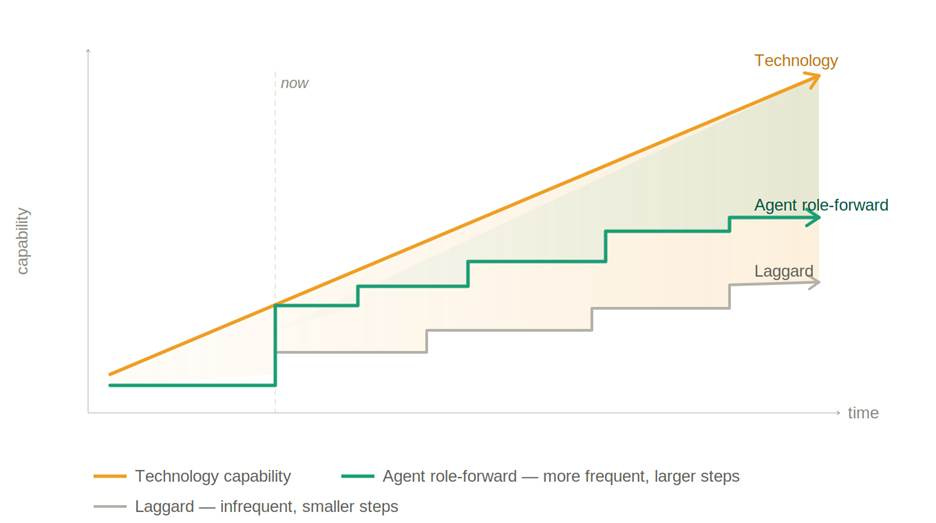
Both companies start from the same point — agents are nascent today. Agent role-forward companies lurch more frequently and by larger increments, staying closer to the technology line. Neither closes the gap fully. The stepwise nature of workflow change doesn’t disappear — it just becomes less punishing.
In the representative figure above, both companies start from the same point—agents are nascent today. Agent role-forward companies lurch more frequently and by larger increments, staying closer to the technology line. Neither closes the gap fully. The stepwise nature of workflow change doesn’t disappear—it just becomes less punishing and more frequent.
With this role, you can transform your entire enterprise faster and reduce “agent chaos”.
Crawford Del Prete is a Senior Advisor at PSG Equity and former President of IDC. He writes about enterprise software, AI, and technology market dynamics. All opinions are his.
Great piece. It’s fascinating to watch the best practices of organizational design and behavior re-written in near realtime.
Ironic that building successful Agentic systems to do things at scale and speed beyond human capacity highlights the value of those rare and talented individuals who can work through the very human reasons it’s hard to build clean data systems, get cross-fucntional cooperation during workflow redesign and all things associated with change management. I’m also reminded of all the transformation projects that failed without effective executive sponsorship. This made me think it might be worth re-reading the classics Re-engineering the Corporation and Teaching the Elephant to Dance.
This also made me appreciate the escalating battle between the AI-native companies who can engineer more efficient agentic workflows from scratch and the existing firms that have gobs of data and existing customers.