How AI Is Reshaping Software Across Three Layers
AI is reshaping software from the bottom up. The companies that survive will understand exactly which layer they’re selling.

There’s a narrative running through AI discourse right now, and it’s my favorite debate de jour: that problems divide cleanly into two types. Knowable ones — computable, deterministic, verifiable — that AI will handle. And judgment ones — strategy, ethics, taste, relationships — that remain human.
It’s an OK starting point. But it breaks down quickly, because every “knowable” problem has judgment hiding inside it.
“Does this code work?” — works for what? Against whose requirements? “Is this X-ray showing a tumor?” — at what sensitivity threshold, set by whom, for which patient population? The fact is that judgment doesn’t sit beside execution — it frames it. Before any computation runs, a human has decided what question to ask, what counts as correct, and what to do when reality falls outside the expected range. AI handles the inner loop. Humans define and own the outer one.
The tighter and more stable that outer envelope — the more constrained and well-specified the problem or task — the more autonomous AI can be. The wider or more novel the situation, the more the human judgment layer has to expand to contain it.
This nested structure is the key to understanding what’s happening to software. Not a binary split, but three distinct layers of software — and AI is reshaping each one differently.
The Three Layers
Every software product, and every company built on software, operates across three layers simultaneously.
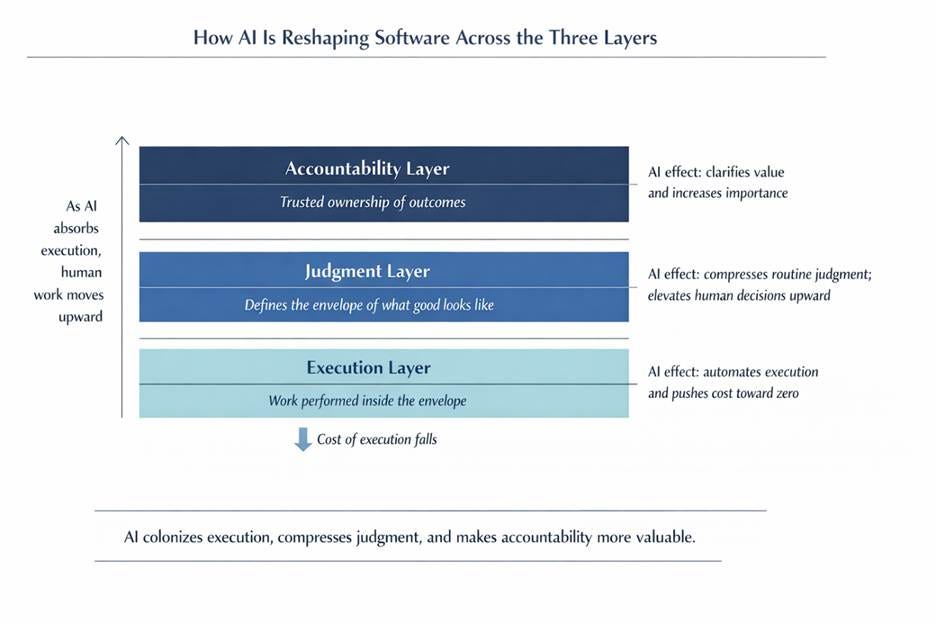
The Execution Layer is the work being done inside the envelope. Scanning, processing, generating, routing, matching. This is what software has always automated, and what AI is now turbocharging to new heights. The cost of execution is collapsing toward zero — and taking with it entire categories of software whose primary job was helping humans navigate workflows to produce outputs.
The Judgment Layer is where the envelope gets defined and maintained. What question should be asked? What counts as a good answer in this specific context? Which of these flagged results “move the needle” for this customer, this situation, this moment? This is where expertise lives. AI assists here — compressing the cognitive tax, surfacing blind spots, extending the reach of whoever is making the call — but a human directs. The judgment layer is not a single decision point. It runs continuously, upstream and downstream of every execution.
The Accountability Layer is where someone is on the hook for the correct answer and the outputs being trusted. Signs the SLA. Gets called at 2am. Stands behind the output in front of a regulator, a board, a patient, or a jury. This layer is structurally human — not because AI lacks capability, but because accountability is a social and legal construct. It requires an entity that can be responsible, and responsibility requires a human to hold it.
Here’s the insight most AI transformation narratives miss: most software companies think they’re selling the execution layer. But customers are often paying for the judgment and accountability layers above it. As AI compresses the cost of execution, the companies that understand this will concentrate value in the layers above. The ones that don’t will watch their margins competed away by tools that do the execution for free.
What This Change Does to Entire Software Categories
Run the three layers across any software category and the picture comes into focus fast.
Legal contract review: The execution layer — reviewing clauses and flagging language — is now highly automatable. The judgment layer — assessing what matters for a client’s risk profile — is where lawyers create value. The accountability layer — standing behind the review, signing off as a partner, and carrying malpractice insurance — is what enterprise clients are paying for. AI improves the firm’s efficiency, but it doesn’t erode the value proposition. It shifts that value upward.
IT helpdesks: Execution is entirely automatable now. Judgment — diagnosing novel or complex issues, managing escalations — survives but compresses. The accountability layer is thin in most enterprise contracts. That’s exactly why this category gets disrupted hardest and fastest. There’s no thick judgment or accountability layer to retreat to.
IT service management: By contrast, ITSM is more durable because it sits closer to systems of record, change control, policy enforcement, asset truth, and workflow orchestration across the enterprise. Even as AI automates frontline support, ITSM still houses the judgment and governance needed to define processes, manage risk, and maintain operational accountability.
Software development: Execution — writing code to a well-specified task — is already heavily AI-assisted and will become more so. The judgment layer — architecture, trade-offs, what to build and why — survives but requires dramatically fewer people, each operating at higher altitude. The accountability layer — we delivered working software, we own the outcome — is what senior engineering leaders sell, and it becomes scarcer and more valuable as junior execution roles compress.
Here’s the pattern: AI absorbs the execution layer, compresses the judgment layer to its highest-value form, and makes the accountability layer the thing customers are ultimately paying for. But that dynamic depends on which layers the customer occupies.
Know Which Layers Your Customer Occupies
The three-layer model isn’t a prescription. It’s a diagnostic. The question isn’t “should my business own outcomes?” It’s “which layers does my customer occupy themselves?”
If your customer is an enterprise buyer in a regulated industry — healthcare, finance, legal, government — they are purchasing above the execution layer. They need someone occupying the judgment and accountability layers on their behalf. For these customers, accountability isn’t optional. It’s the product. A tool that automates execution but leaves them holding the bag for the output is only half a solution.
But if your customer is a developer, a technically sophisticated operator, or a creative professional — someone who is the judgment and accountability layer — the dynamic inverts entirely. They don’t want a vendor owning the outcome. They want the execution layer as clear and accessible as possible, maximum transparency, maximum control. For this customer, the value is in control, not in offloading accountability.
This is why developer tools, open-source models, and creative AI are durable businesses even though they never “own” outcomes. Their customers are the accountability layer. The product is execution excellence in service of someone else’s judgment.
The three-layer model is a map. Know which layers your customer occupies. Sell into the ones they don’t. The companies that get into trouble are the ones misreading where their customer sits — either abdicating accountability to customers who need it held for them or trying to own outcomes for customers who need to own them themselves.
What This Means for Applications and Platforms
A natural question follows: if AI consumes the execution layer, does the software landscape consolidate? Will there be fewer apps?
I think the opposite, in fact at IDC we famously predicted that app development would explode. As execution cost collapses, the barrier to building falls with it. You’ll get an acceleration of hyper-specific tools — for micro-niches, single workflows, individual companies, even individual users. The number of apps goes up dramatically. What is challenged is the fat middle: general-purpose workflow hubs that existed primarily as connective tissue between humans doing execution work.
However, platforms don’t weaken. Their leverage point shifts.
When the app layer fragments into thousands of short lived, hyper-specific tools, something becomes precious: context. An app generated on demand for a 20-minute workflow still needs to know who you are, what you’ve done before, and have permission to act on your behalf. It can’t bootstrap the judgment and accountability layers from scratch. It needs to plug into them.
The old platform value proposition was “we give you OS primitives and distribution.” The new one is likely “we give you identity, history, and the context that makes agents useful.” The most powerful platforms going forward aren’t the ones bolting AI features onto existing products. They’re the ones that quietly own the richest context about your work, your customers, your health, your decisions — the raw material herewhere the judgment layer runs.
The Moving Envelope
One last thing: the envelope doesn’t stay fixed; it is moving quickly.
Points we once thought required human judgment — reading an X-ray, translating a poem, reviewing a boilerplate contract — have moved into the execution layer faster than anyone expected. The boundary keeps shifting, and it shifts in one direction. Some of what sits in the judgment layer today will be execution by 2030.
This doesn’t mean human judgment disappears. It means the altitude at which judgment operates keeps rising. Humans stop specifying which clauses to flag and start specifying what legal risk tolerance the business should carry. Stop diagnosing which pixel pattern indicates a tumor and start deciding which screening populations to prioritize. Stop writing functions and start making architectural bets.
The role of humans in software isn’t shrinking. It’s ascending. Every time AI absorbs another layer of execution, the judgment layer moves up a floor — to decisions that are harder, higher-stakes, and more consequential. The accountability layer moves with it.
Which means the question for every person and every company in software right now isn’t “will AI replace me?” It’s “am I moving up fast enough?” The execution floor is rising. The people doing best are the ones already on the floor above.
What to Watch
• App topology inverts: The distribution flips from a few dominant platforms plus a long tail, to infinite hyper-specific tools — including short-lived ones generated on demand. The fat middle hollows out. The long tail explodes.
• Platforms own context, not just distribution: Platform leverage expands from “where apps live” to “who owns the context that makes agents useful.” Identity, history, and permission become the new moats.
• Outcome pricing replaces seat pricing: As execution costs collapse in well-specified domains, per-outcome pricing emerges. You’re not paying for access to software. You’re paying for a result with someone accountable for it.
• Verification becomes a business: As AI generates more output, trusted verification — humans and systems that can confirm the AI got it right, within the right envelope — becomes scarce and valuable. New businesses will be built entirely for this “job”.
• The envelope as product: The most defensible software businesses going forward won’t be the ones with the best models. They’ll be the ones with the best-defined envelopes — the deepest understanding of what “correct” means in their specific domain, for their specific customer, with their specific consequences.
These are the layers that need focus now. The execution layer is being automated. The judgment layer is being elevated. The accountability layer is being clarified. It’s critical that every software business needs to know exactly where it lives — and whether it’s moving in the right direction.
Crawford Del Prete is a Senior Advisor at PSG Equity and former President of IDC. He writes about enterprise software, AI, and technology market dynamics. All opinions are his.