Why Open Source Eventually Wins the AI Market

On July 27, Moonshot AI, a Beijing-based lab most Americans had never heard of two years ago, shipped the full weights for Kimi K3, a 2.8-trillion-parameter model released under an MIT license. It followed K2, K2.5, K2.6, and K2.7 in a cadence that has gone from curiosity to habit since Moonshot’s first open release in July 2025. K2.6 already ranks fourth among all models tracked by Artificial Analysis and first among open-weight models, beating GPT-5.4 and Claude Opus 4.6 on SWE-Bench Pro, while costing roughly a sixth as much per token as its closed competitors. Perplexity added it to their model picker. None of this required a partnership.
This is not a story about one scrappy lab catching up. It’s yet another example of what happens to every technology market once the underlying components get “good enough. Clayton Christensen spent much of his career describing this pattern, and it’s highlighting what his theory says, because the AI industry is currently living through the exact transition he mapped.
Interdependence, then modularity
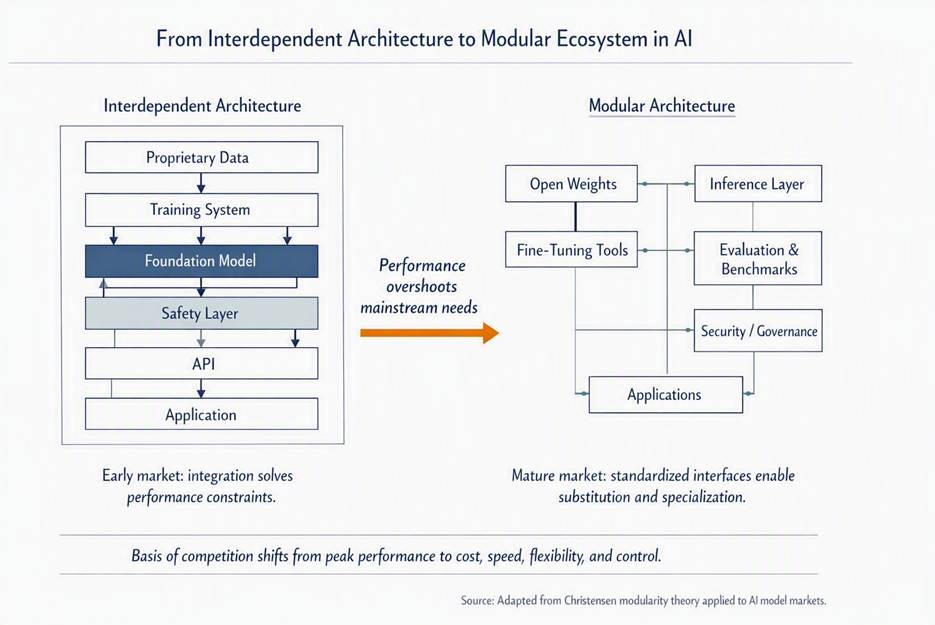
Modularity theory splits product architectures into two types. An interdependent architecture is one where components depend on each other in unpredictable ways — you can’t swap one part without redesigning the others, so a single team must control the whole stack to make it work. A modular architecture is one where the interfaces between components are so well understood that it stops mattering who builds each piece, if it meets specification.
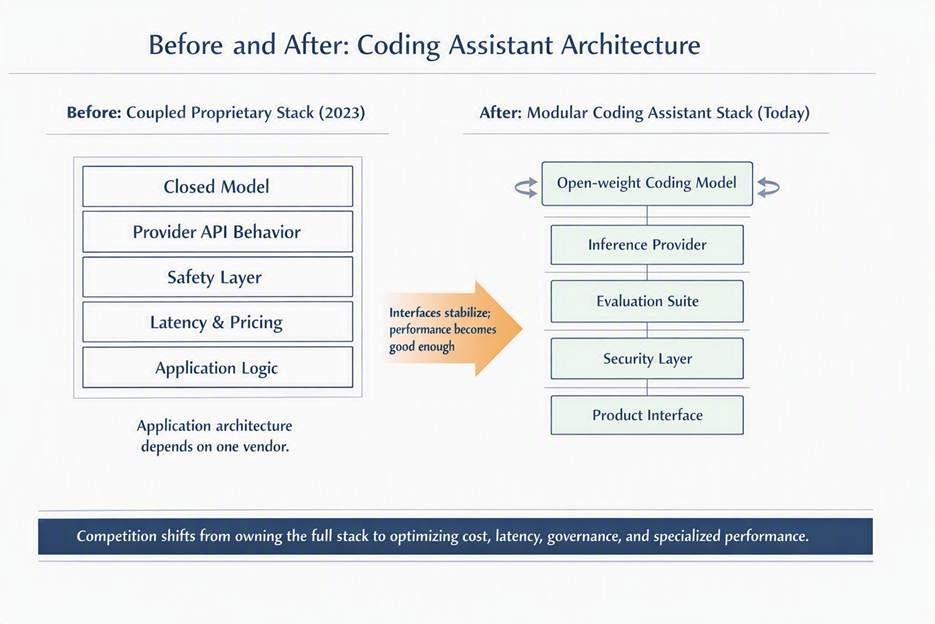
The theory focuses on sequencing. Interdependent architectures win early, when a given technology doesn’t yet perform well enough for mainstream use. Tight integration at the system level is how you squeeze out the last bit of performance when nothing is good enough yet — think mainframes, with vertically integrated hardware and software stacks, or the first iPhones without volume app stores where all of the apps were developed by Apple, or more recently, GPT-4-era foundation models where every serious application had to be built tightly around one vendor’s proprietary stack. A coding assistant is a good example: in 2023, the model, API behavior, safety layer, latency, pricing, and application logic were effectively one coupled system; today, a team can pair an open-weight coding model with a separate inference provider, evaluation suite, security layer, and product interface, then swap models as cost or performance changes.
But once performance overshoots what most users need, the basis of competition flips. Customers stop paying a premium for integration and start rewarding cost, speed, flexibility, and the ability to mix and match. The architecture modularizes, and the value shifts to whoever controls the newly commoditized interface, or to whoever builds the best specialized piece on top of it.
Frontier AI is now starting that transition. For the first two or three years of the large language model era, the leading models were closed and closed for a defensible reason: nobody else could match the performance, so the integrated, proprietary stack was the only way to ship something usable. Kimi K2.6 beating Opus and GPT-5.4 on a hard coding benchmark, at a fraction of the cost, is the signal that this era is ending. The model layer is becoming a module — a component with a well-specified interface (a chat completion API, an open weights file, a benchmark score) that increasingly doesn’t matter who built it. That’s the condition under which Christensen’s theory predicts open, modular ecosystems start beating closed, integrated ones. Open source doesn’t cause this shift; it’s the natural organizational form that shows up once the shift is already underway. This is where innovation gets fueled, in three specific places.
Cost is a Major Driver
The most direct effect of modularization is price collapse at the commoditized layer, and open weights are the accelerant. When Moonshot can give away a model that competes with the best closed systems, every lab pricing a comparable model must justify its premium or cut it. That’s what happened after DeepSeek’s releases in 2025, and it’s happening again now — Kimi’s roughly 6x cost advantage on frontier-class coding performance is repricing of the entire category. Cheaper tokens don’t just help price-sensitive users; they change what gets built. The category expands. Applications that were previously uneconomical at $15 per million tokens become trivial at $2.50. The innovation shows up downstream, in the long tail of products that only make sense once inference is cheap enough to run at scale.
Security will likely improve
The security argument for open source AI cuts in a direction that surprises people who assume “open” means “less controlled.” A closed model is a black box: you can prompt it and observe outputs, but you can’t inspect weights, audit training data, or verify what a vendor claims about safety testing. An open-weight model can be red-teamed by anyone, fine-tuned to remove unwanted behavior, run in an air-gapped environment with no data leaving your infrastructure, and inspected line by line if something goes wrong. The practical advantage is people: one company, no matter how capable, cannot see every exploit path, deployment context, or failure mode as quickly as a broad technical community can. There simply are not enough hands inside a single vendor to match thousands of independent researchers, customers, and developers stress-testing the same system from different angles. That’s the logic behind the Open Secure AI Alliance that NVIDIA and roughly forty other organizations launched on July 27, the same week as Kimi K3 — a coalition explicitly built around the idea that open tooling, not proprietary opacity, is how you defend AI systems at scale.
This isn’t a one-sided argument. There’s a debate about whether open weights increase security by enabling scrutiny or increase risk by handing capable models to bad actors, and the geopolitical version of that debate — American officials arguing that Chinese open-weight models carry security risks that Western ones don’t — is playing out in real time as Kimi’s releases get more attention. Reasonable people disagree on where the line sits. But the direction of the innovation is clear either way: open models are forcing the entire industry to build better auditing, evaluation, and containment tooling than a purely closed ecosystem would have produced on its own, because openness makes the failure modes visible instead of hidden behind a vendor’s terms of service.
Governance
The governance case is compelling. A modular, open ecosystem gives every downstream actor — a hospital, a bank, a government, a small startup — the option to govern the model itself rather than trust a vendor’s governance. That means the ability to fine-tune away behaviors you don’t want, keep training and inference data entirely on-premises for regulatory compliance, fork a model when a vendor’s policies change, and audit a system’s behavior instead of accepting a provider’s documentation. None of that is available when the model is a closed API you can only prompt. Kimi’s MIT license is a governance decision as much as a technical one: it says any organization, anywhere, can decide for itself how the model should be constrained, deployed, and monitored, rather than inheriting one lab’s defaults.
The pattern, not the model
None of this is really about Kimi. Kimi is just the clearest current instance of a pattern Christensen described decades before anyone was training transformers: technologies modularize once they get good enough, and open source is the form modularization is taking in AI. That should be good news for the industry. When the model layer becomes more open, cheaper, and easier to substitute, innovation does not disappear; it spreads. The tightly integrated stack begins to disintegrate into separable layers, each with its own specialists, incentives, and pace of improvement. More companies can compete on inference efficiency, evaluation, security, governance, fine-tuning, deployment, vertical applications, developer experience, and user workflow.
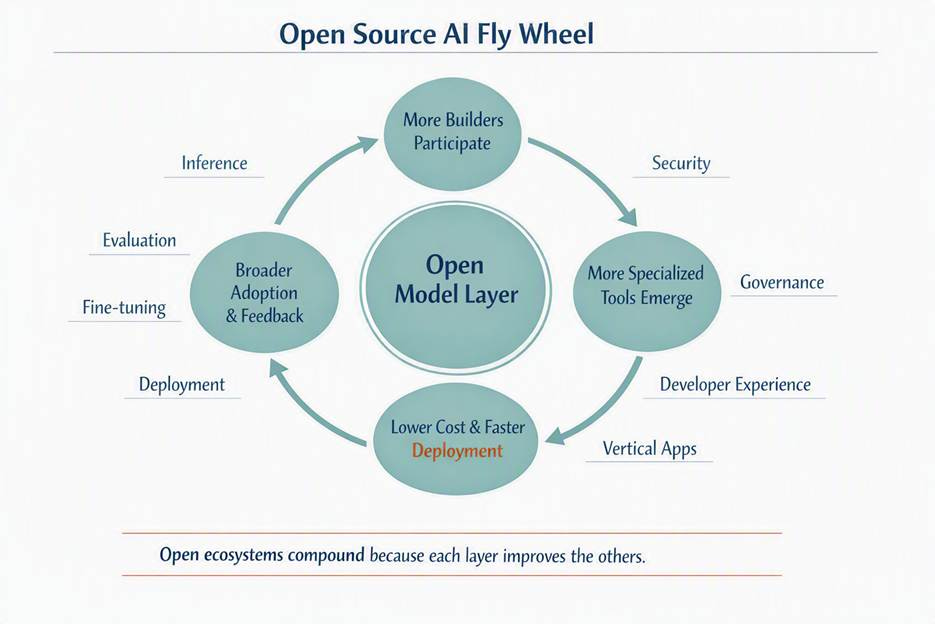
The market gets larger because more builders can participate at more layers of the stack. Lower costs, better security tooling, and real governance optionality are not side effects of open source AI — they are what happens when an ecosystem has enough hands, enough incentives, and enough freedom to improve every component at once. The next phase of AI will not be defined by one closed model winning everything. It will be defined by a thriving open ecosystem where innovation compounds across the stack.